Know what happened.
Follow agent actions, execution attempts, and outcomes in a single, searchable history.
See what your AI agents do. Catch duplicate actions.
Investigate the unexpected—all from one local dashboard.
npm install mola-ledgerNo account. No ledger API key. No extra services.
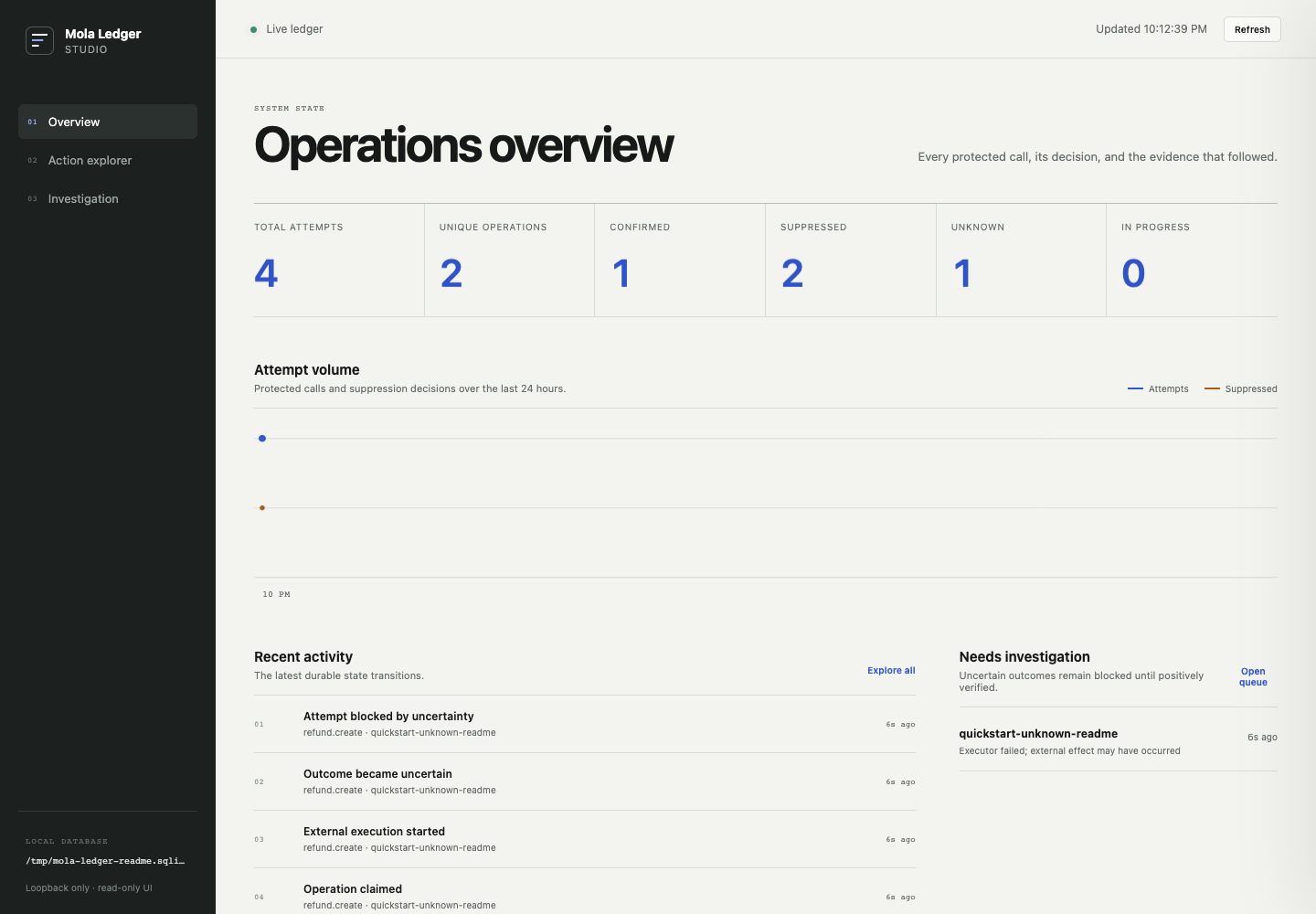
Follow agent actions, execution attempts, and outcomes in a single, searchable history.
Recognize the same intended action and return its confirmed result without running it again.
When an outcome is uncertain, block blind retries and keep the evidence ready for review.
Keep your agent. Keep your tools. Wrap the actions that matter, then open Studio to see their history.
Add the package to your Node.js application.
Give it a stable ID that stays the same on retries.
See attempts, repeats, and outcomes as they happen.
import { createLedger } from 'mola-ledger';

const ledger = createLedger();

// Same intended action. Same ID.
const incident = await ledger.execute({
  id: 'incident-for-alert-1842-v1',
  action: 'incident.create',
  input: { alertId: 1842 },
  run: ({ idempotencyKey }) =>
    provider.createIncident({
      alertId: 1842,
      idempotencyKey,
    }),
});Integration example: provider is your existing client. Close the ledger during application shutdown.
Explore what happens when your agent calls the same protected action again.
The first call runs your action and saves its confirmed result. You can inspect the operation and its history in Studio.
incident-for-alert-1842-v1Protection applies to wrapped calls using the same stable identity and shared local ledger. Mola Ledger does not guarantee exactly-once external execution.
Start with a dashboard that lives alongside your application. No extra service to manage.
Monitor and protect actions in your Node.js app. Search operations, follow timelines, and investigate uncertain results.
A shared view across deployed agents, with an open-source, self-hosted server package. Follow development and releases on GitHub.
Install the SDK. Wrap an action. Open Studio.
npm install mola-ledgernpx mola-ledger studioNode.js 22.16+ · Wrap your action between these steps.
Before npm release, use the source installation in the quick start.
Mola Ledger lives on GitHub. Read the source, try the examples, report an issue, or contribute an improvement.
View on GitHub ↗A lightweight agent action ledger with duplicate protection and a built-in local dashboard.
Explore the latest activity on GitHub.Mola Ledger is a framework-neutral Node.js SDK. Wrap your tool functions with ledger.execute(). The documentation includes an OpenAI Agents SDK and GitHub Issues example. Calls that bypass the wrapper are not tracked or protected.
A timeout may mean the external service acted but its reply was lost. Mola Ledger records the uncertain outcome and blocks blind retries. Verify the result with the provider, then reconcile through the SDK.
The local ledger stays on your machine. Studio is a read-only dashboard available on localhost. It is not designed to be exposed to the public internet.
The current release coordinates through one local ledger. It does not coordinate independent hosts or serverless instances. A compatibility HTTP backend exists for small single-host evaluation; centralized remote monitoring is planned.